
Scaling Insurance through AI: The Story of Owl.co
Bringing Precision and Trust to Insurance Through AI
In 2017, brothers Sean and Sohrab Merat were not looking for an easy market.
Insurance was not glamorous. It was not fast-moving. It was not known for welcoming innovation. It was, in fact, one of the most regulated and conservative industries in North America.
And that was precisely the point.
Every person in every room carries insurance in some form. And yet, when claims are filed, frustration often follows — long processing times, inconsistent decisions, opaque outcomes. Insurance companies, for their part, wrestle with fraud, leakage, rising loss ratios, compliance risk, and customer dissatisfaction.
Sean and Sohrab saw something others overlooked: claims handling wasn’t just an operational function — it was a data problem.
If insurers could see the full picture of a claim quickly, consistently, and objectively, they could reduce risk, improve accuracy, and deliver a better experience to policyholders.
They chose the name Owl deliberately. An owl is trusted. It is wise. It sees in every direction. The ambition was simple but bold: give insurers a 360-degree view of what is really happening inside a claim.
What started as a vision between two brothers became the foundation of an AI-driven enterprise platform serving insurers across Canada and the United States.
Earning Trust in a Conservative Market
The early years were not about scale. They were about survival and credibility.
Insurance buyers do not adopt new technology lightly. Compliance, privacy, information security, and regulatory risk are real constraints. Before any conversation begins, vendors must prove accuracy, data security, and defensibility.
Owl’s early breakthrough came when it secured its first major Canadian enterprise client. That initial trust was catalytic. In conservative industries, one strong reference can open doors that cold outreach never could.
What Sean and the team learned quickly was this: in enterprise insurance, accuracy matters more than price.
Insurers would rather pay more for a solution they trust than risk incorrect decisions that carry financial and reputational consequences. Owl positioned itself not as a cost-cutting tool, but as a precision partner — helping insurers:
shorten claims cycle times
improve decision consistency
reduce leakage and fraud exposure
free up adjusters to focus on customers rather than paperwork
The company adopted an intentional cultural language shift: they do not call clients “customers.” They call them partners. The distinction matters. In a new AI category, both sides are learning together.
From Startup Chaos to Scale-Up Discipline
Like many startups, Owl’s early phase was defined by urgency and improvisation.
In the startup stage, as Shams Albayati describes it, the team was “changing the tires while driving the car.” Roles overlapped. Executives wore multiple hats. Engineers shipped quickly. Perfection was secondary to progress.
But as enterprise traction grew — and with venture backing to accelerate expansion — the organization had to evolve.
The shift from startup to scale-up brought a new set of challenges:
Sales cycles stretching 12–14 months
Enterprise pilots requiring extensive collaboration
The need to formalize compliance and security frameworks (including SOC 2 Type II)
Balancing innovation with reliability
The hardest part was not technical. It was cultural.
How do you keep a team energized when enterprise deals take over a year to close?
How do you maintain startup speed while building enterprise discipline?
Owl doubled down on transparency. The organization operates flat. Engineers know where partners are experiencing pain points. Meetings are open. There is minimal hierarchy. Even today, Sean is described internally as indistinguishable from anyone else in the office — approachable, informal, focused on execution.
The company now employs over 50 people across Canada and the United States, with a lean engineering team competing successfully against much larger competitors. The scale-up phase has introduced more structure, more deliberate product optimization, and greater strategic planning — but the cultural DNA remains collaborative.
Riding the AI Inflection Point
Owl operates at the intersection of two powerful forces: artificial intelligence and enterprise risk management.
Over the past two years, the market tone has shifted noticeably. What was once experimentation has become an expectation. Insurance boards are now asking management teams how AI is being implemented, not whether it should be.
Last year was about pilots. This year is about purchasing.
For Owl, this shift is both opportunity and pressure. The company must stay ahead of technological change while serving buyers who adopt cautiously. In many ways, the conservative pace of insurance gives Owl an advantage — they can innovate quickly internally while guiding partners thoughtfully through adoption.
But scale introduces new realities.
One of the most significant forward-looking challenges is computing cost. AI infrastructure is expensive. As usage increases, leaders must carefully balance internal compute economics with external pricing strategy. These are not startup problems; they are scale-up economics questions.
The founders are candid that they are still only scratching the surface of what the platform can do. The strategy over the next five years is clear: land and expand. Enter through one business unit and then extend across legal, underwriting, special investigations, medical review, and beyond.
The vision is not to replace human judgment — but to enhance it with clarity and speed.
The ScaleUP Lessons
Owl’s journey offers several lessons for ambitious companies scaling in complex markets:
1. Choose a hard market on purpose: Conservative industries create high barriers to entry — and high defensibility once trust is earned.
2. Trust is the product: Accuracy, compliance, and reliability are growth levers in enterprise markets.
3. Enterprise sales demand endurance: Long cycles test culture more than cash flow. Transparency and shared purpose keep teams aligned.
4. The shift from startup to scale-up is organizational, not just financial: Optimization, process design, and structural clarity become as important as product innovation.
5. Stay curious in fast-moving spaces: AI is evolving daily. The companies that win are those that combine technical ambition with disciplined execution.
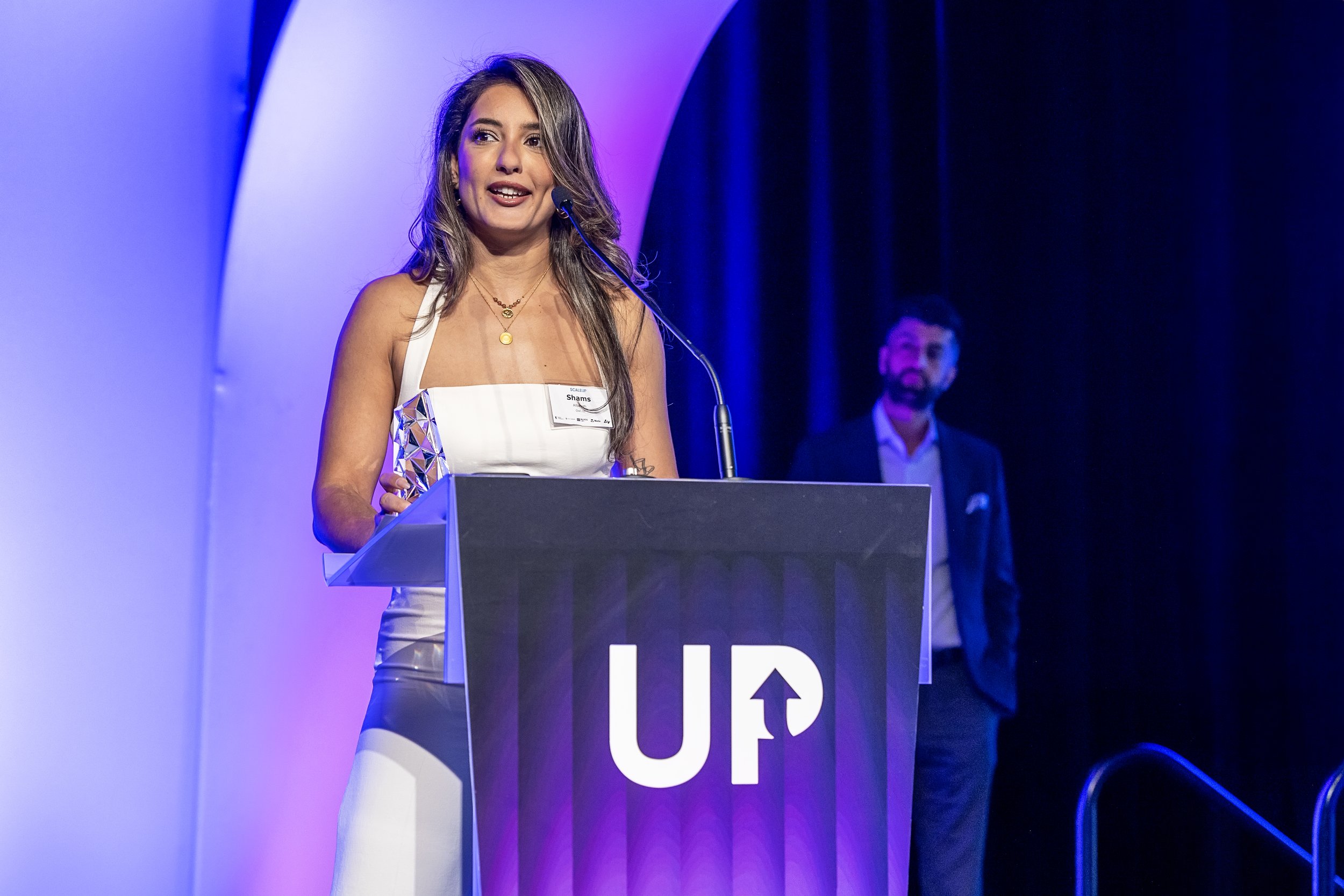
Shams Albayati, VP of People at Owl.co, accepting the 2025 Emerging ScaleUP of the Year Award at the Awards Gala
Where next?
From a conversation between two brothers in 2017 to the Emerging ScaleUP Of the Year for 2025, Owl.co’s story of an enterprise AI company serving North American insurers is still being written.
They chose wisdom over speed, partnership over transaction, and precision over hype.
And in a sector built on managing risk, that might be the boldest strategy of all.